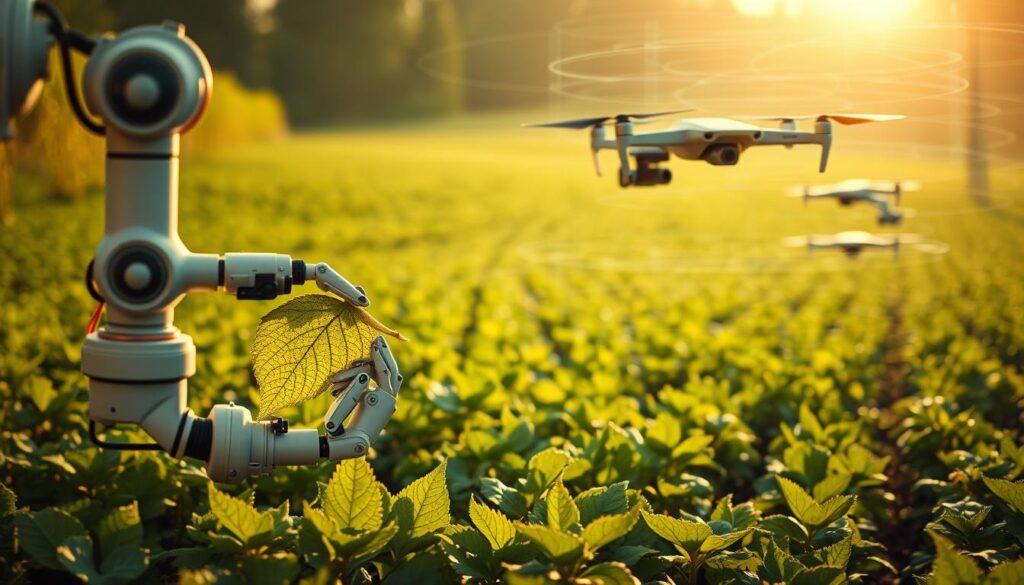

Could AI in Plant Science be the single most practical tool to secure your harvest while cutting costs and emissions? Artificial intelligence in agriculture is now transitioning from lab demonstrations to real-world fields. USDA trend reports and recent peer-reviewed reviews show that AI in Plant Science helps growers reduce water, fertilizer, and pesticide use while holding or raising yield per acre. This shift is important for sustainable agriculture in the United States, where resilience to drought and pests directly affects farm income and food security.
Major players like Syngenta Digital, Corteva Agriscience, BASF digital initiatives, and Benson Hill, along with research hubs at UC Davis and Iowa State, are deploying tools. These tools turn sensor data and genomic information into actionable decisions. The result is measurable: lower input costs, fewer greenhouse gas emissions, and faster responses to stressors in the field.
This article will walk you through definitions and the technical building blocks—data, models, and deployment—then show how machine learning speeds breeding, how phenotyping scales from lab to field, and how computer vision, IoT, and edge AI power precision agriculture with AI. You’ll also read real case studies, learn adoption barriers, and see what’s next for sustainable agriculture.
Key Takeaways
- AI in Plant Science reduces inputs while maintaining or increasing yields.
- Artificial intelligence in agriculture delivers measurable value: cost savings, emissions reductions, and resilience.
- Leading agribusinesses and universities are already scaling practical AI tools for growers.
- Precision agriculture with AI links sensors, models, and field action to improve outcomes.
- The article will cover technical building blocks, real-world examples, and future trends to help you evaluate adoption.
Understanding AI in Plant Science: Transforming Research and Farming
Data-driven farming changes how we manage crops and conduct experiments. AI in plant science uses methods like machine learning and computer vision. It helps with tasks from finding new traits to scouting fields.

Defining AI in plant science and its role in modern agriculture
AI is like a toolbox that uses algorithms on biological and environmental data. It uses neural networks to analyze images of leaves for disease detection. It also predicts yield based on weather and management history.
These tools help move from traditional methods to targeted, predictive actions. They adapt to the specific needs of fields or plant groups.
How artificial intelligence in agriculture differs from traditional agritech
Traditional agritech focuses on mechanization and chemical inputs. AI in agriculture adds pattern recognition and predictive analytics. This leads to autonomous decision-making that adapts to changing conditions.
Key components: data, models, and deployment in field conditions
Data is the foundation for every model. You’ll use genomic sequences, images, soil sensor logs, and weather feeds. Public repositories like USDA-NASS and NASA Earth Observing System provide valuable data.
Choosing the right model depends on the question. Supervised learning is good for tasks like disease detection. Unsupervised methods reveal new insights. Transfer learning adapts models across different crops and regions.
Deployment is key for practical use. Cloud analytics handle training workloads. Edge AI runs on devices for quick actions. Integrating with farm systems lets you apply variable-rate applications.
Be prepared for a phased ROI. Initial investment is in sensors and data annotation. Then comes model tuning and deployment. With the right approach, AI in plant science boosts efficiency and decision quality.
How Machine Learning for Plant Research Advances Crop Development
Machine learning helps speed up plant breeding and improve trait selection. It turns genetic data into useful choices. This makes programs more efficient and focused.

Genomic prediction links genetic makeup to traits like yield and disease resistance. It uses models like genomic best linear unbiased prediction and deep neural networks. These models work with dense genetic data.
Studies show machine learning is more accurate than old methods. It reduces the need for large field trials. It’s reliable because it uses data from different environments to avoid overfitting.
Tools help find genetic markers linked to good traits. This guides breeders to make better choices. It helps them focus on the most promising crosses.
Genomic selection predicts how well offspring will do early on. This shortens the breeding cycle. It lets you test more candidates in a year.
Real-world examples show the benefits. CIMMYT’s wheat and Corteva and Bayer’s maize projects have seen big gains. Rice and soybean projects have also improved stress tolerance thanks to machine learning.
To use machine learning, you need dense genetic data and solid cross-validation. Ensure your data is accurate and you have sufficient samples. This ensures the predictions work well across different places.
| Aspect | What it delivers | Practical note |
|---|---|---|
| Genomic prediction | Predicts trait values from genotype | Use BLUP or DNNs with multi-environment data for accuracy |
| Trait selection | Identifies key markers and regions | Apply feature-importance tools to prioritize crosses |
| Breeding acceleration | Shortens cycle time, increases selection rounds | Integrate with speed breeding and controlled environments |
| Case implementations | Higher yields and faster cultivar release | Examples: CIMMYT wheat, Corteva/Bayer maize, rice drought programs |
| Data needs | Dense genotypes, multi-site trials | Ensure quality, replication, and cross-validation |
Plant Phenotyping Using AI: From Lab to Field
Plant phenotyping with AI connects lab studies to real-world tests. This part talks about common platforms, the data flow for AI, and how it saves time and money for breeders and researchers.
High-throughput phenotyping platforms and data pipelines
There are many options like conveyor systems, automated greenhouses, and gantry rigs at places like the University of Nebraska and the University of Arizona. For field work, drones and tractors with sensors capture data on plants’ health and structure.
The data journey starts with taking pictures, then goes through steps like fixing images and adding labels. After that, models are trained and stored in the cloud or on local servers, fitting your needs.
Translating phenotypic insights into practical breeding decisions
Traits like leaf size, temperature, and root health are used in selection models. These help pick the best plants for certain conditions and traits related to growth and stress.
These insights are used in breeding by managing field trials, analyzing data, and setting rules for moving plants forward. This turns complex data into clear choices for the next breeding round.
Reducing time and cost with automated phenotyping workflows
AI replaces manual checks, making it faster and more consistent. Reports show a big increase in observations and a drop in costs per sample.
To keep up, use standard methods, quality annotations, and ways to adapt models for different places and sensors. These steps make AI phenotyping reliable and big enough for your breeding needs.
- Platforms: conveyor systems, automated greenhouses, gantries, UAVs, tractor mounts
- Pipeline steps: acquisition, correction, annotation, training, storage
- Outputs: selection indices, genomic models, decision thresholds
Computer Vision in Plant Science for Disease and Pest Detection
Computer vision in plant science helps spot disease, pest damage, nutrient stress, and heat injury early. It uses images from RGB, multispectral, and thermal sensors. These images are then analyzed by deep models to find subtle symptoms that might be missed.
Convolutional neural networks and vision transformers are very good at finding lesions, discoloration, and gaps in the canopy. They learn from expert-labeled datasets to tell the difference between disease and environmental stress. Studies show they can detect problems earlier than humans can.
Mobile apps like Climate FieldView, Taranis, and Plantix let growers diagnose issues with a smartphone photo. They get quick analysis and advice. This technology also works on drones for aerial views of large fields.
Drones create detailed maps of fields, showing where diseases are most active. These maps help target spraying and focus scouting efforts. This integration with farm management systems improves efficiency and reduces waste.
Early detection and precise targeting of treatments can reduce pesticide use and improve success rates. Treating smaller, accurately defined areas saves money and reduces harm to non-target species. This is a key advantage of AI in agriculture.
It’s important to test and validate models for reliable results. Balance false positives with missed detections by testing under different conditions. Keep training sets up to date to maintain accuracy as pests and diseases change.
For consistent results, sample fields regularly and use a combination of RGB, multispectral, and thermal images. Link model outputs to spray rigs or advisory services to act quickly on alerts.
| Component | What it tell you | Practical tip |
|---|---|---|
| RGB images + CNNs | Visible lesions, discoloration, pest feeding patterns | Use smartphone scouting for instant field triage |
| Multispectral data | Chlorophyll stress, early nutrient deficiency markers | Include NIR band to detect stress before symptoms appear |
| Thermal imagery | Transpiration changes, heat stress, stomatal closure | Survey midday for clear thermal contrast |
| Vision transformers | Complex pattern recognition across scales | Use for heterogeneous fields and mixed infections |
| Drone mapping | Spatial spread, hotspot delineation, prescription zones | Fly weekly during outbreaks; integrate with application tools |
| Model maintenance | False-positive/negative control, adaptability | Retrain with seasonal labels and edge-case samples |
Precision Agriculture with AI: Optimizing Inputs and Resources
Letting data guide your field decisions can cut costs and protect the environment. Precision agriculture with AI uses maps, sensors, and models to match inputs to needs. This approach reduces waste and boosts efficiency.
AI helps create custom plans for seed, fertilizer, and pesticides. These plans are based on soil tests, yield maps, and crop health. Tools like John Deere Operations Center and Precision Planting make these plans work in real-time.
AI also improves water and nutrient management. It combines soil moisture sensors, weather forecasts, and crop data. This leads to better timing and amounts for irrigation and fertilizers, saving water and improving crop health.
Targeted inputs reduce runoff and lower pesticide use. Studies show this approach can cut nitrate losses and lessen water pollution. It also reduces harmful emissions, saving money and protecting the environment.
To begin, start with soil tests and historical data. Calibrate models and test them in phases. Combine AI with your experience to refine recommendations and build trust.
| Area | AI Role | Real-world Platforms | Expected Benefit |
|---|---|---|---|
| Variable rate application | Generates prescription maps from spatial data and imagery | John Deere Operations Center, Precision Planting, Trimble, Raven | Lower seed and fertilizer waste; higher input-use efficiency |
| Irrigation & fertigation | Predicts timing and amounts using sensors and weather models | Center-pivot controllers with sensor integrations and cloud analytics | Reduced water use; improved nitrogen uptake |
| Environmental impact | Targets treatments to reduce runoff and emissions | Farm management systems with geospatial decision layers | Lower nitrate runoff; reduced nitrous oxide; better compliance |
| Adoption strategy | Phased deployment and local calibration of models | Advisors, equipment dealers, agronomy services | Validated ROI; faster grower confidence |
AI in plant science is key to smarter farming. Start small, measure results, and expand what works for your farm.
Smart Farming Technology: IoT, Sensors, and Edge AI Integration
You need systems that turn raw data into clear actions. Smart farming technology combines sensor networks, on-site analytics, and farm software. This setup helps you react quickly to stress, pests, and weather changes while keeping costs low.
Sensor networks feeding models for real-time decision support
Start with common sensors like soil moisture and nutrient probes, and canopy spectral sensors. Also, use compact weather stations, greenhouse CO2 meters, and pest traps with image capture. These devices give your models the raw signals they need for accurate recommendations.
Use strong architectures like LoRaWAN mesh, NB-IoT, or cellular backhaul for telemetry. Set sensible ingestion rates to balance battery life and data fidelity. Clean incoming streams to handle missing values and sensor drift before models use the data.
Edge AI for low-latency, energy-efficient field analytics
Run inference on devices like NVIDIA Jetson, Intel Movidius, or purpose-built microcontrollers. This minimizes latency and bandwidth. Edge AI lets irrigation valves respond immediately to moisture drops. It also powers vision models inside insect traps so you identify pests on site.
Local processing saves energy and protects bandwidth when farms lack reliable connectivity. Design models with quantization and pruning so they fit constrained hardware without losing critical accuracy.
Interoperability between farm management systems and AI tools
Integration depends on standards and stable APIs. Link AI outputs to FMIS platforms like Climate FieldView, Granular, or John Deere Operations Center. This way, recommendations become actionable in your machinery and field plans.
Follow ISOBUS for equipment telematics and adopt common data models to preserve portability. Secure device management, staged firmware updates, and clear data governance are essential. They keep models reliable and auditable.
- Practical tip: map each sensor to a single measurement stream and timestamp to avoid merging errors.
- Practical tip: schedule over-the-air firmware updates in low-activity windows to reduce risk.
- Practical tip: document APIs and data schemas so partners can consume outputs safely.
Case Studies: Successful Implementations of AI in Plant Science
Real-world examples show how AI in plant science helps farms and research labs. You’ll learn about commercial uses, academic breakthroughs, and startup partnerships. These stories aim to show you how to apply these successes to your own operation.
Commercial farms using AI for yield improvement and cost savings
Large farms and specialty growers have adopted AI tools like Climate FieldView and Taranis. These tools create AI-driven maps and automate scouting. A Midwestern farm saw a 6–9% yield increase after using these tools for two seasons.
Specialty growers detected pests earlier and used 20% less fungicide in one season. Field sensors with Conservis helped contractors save on labor. These examples show how AI can lead to higher yields and lower costs.
Research institutions demonstrating accelerated breeding outcomes
Universities like UC Davis and Iowa State have used AI to speed up breeding. They’ve seen shorter breeding cycles and better trait gains. This is thanks to predictive models that rank crosses before field trials.
A project at Iowa State combined AI with high-throughput phenotyping. This cut selection time by one generation and improved drought tolerance. UC Davis teams published results that moved candidates from greenhouse to field faster.
Startups and partnerships scaling AI solutions for growers
Startups like Benson Hill and CropX have commercialized AI services. Their business models include SaaS subscriptions and revenue-share deals. These models help growers save money and increase yields.
Partnerships with major agrochemical firms have helped spread AI tools. Growers can test pilot plots and refine models. Startups work with extension services to ensure adoption and improve models.
Comparative outcomes and lessons learned
| Use case | Representative partners | Documented outcome | Business model |
|---|---|---|---|
| Variable-rate seeding & inputs | Climate FieldView, Conservis | 6–9% yield increase; ROI 12–24 months | SaaS + implementation fee |
| Automated scouting & pest detection | Taranis, Vivent | 20% drop in fungicide use; earlier detection | Subscription + hardware leasing |
| Genomic selection acceleration | UC Davis, CIMMYT | One-generation time savings; improved stress traits | Research collaborations; licensing |
| Soil analytics & irrigation | CropX, CropX partners | Reduced water use; optimized fertilizer timing | Hardware-as-a-service; revenue share |
These case studies show several important themes. On-farm validation is key. Extension support and grower training boost adoption. Using local data for model improvement ensures relevance.
Overcoming Challenges: Data, Adoption, and Ethical Considerations
AI tools can greatly improve your farm and research labs. But, you must tackle data quality, adoption, and ethics. Here are steps to move from pilot projects to reliable systems for growers of all sizes.
Data is key for AI systems. You’ll face issues like noisy sensors and mixed file formats. Also, thin public datasets for many crops and regions are a problem. Legal and commercial limits make sharing data hard.
Use standards like MIAPPE for metadata and BGI-style ontologies to align datasets. Federated learning trains models across partners without moving raw field data. Active learning reduces labeling costs by focusing on the most useful samples. These steps help address common data challenges in agriculture.
Adoption barriers include high costs and poor connectivity. Limited digital skills among crews and unclear ROI also pose challenges. Start with small pilots and work with trusted services like John Deere and Bayer.
Quantify results with clear KPIs like input savings and yield lift. Show payback timelines. Offer training for crews and use offline-capable systems when connectivity is weak. Financing options make advanced tools affordable for midsize farms.
Ethical AI in agriculture requires attention to bias, privacy, and fair access. Models trained on one region can fail in another. Build representative datasets and document validation results. Adopt model cards and audit logs for tracing performance.
Clarify who owns field data and how it’s used. Follow data stewardship best practices and review U.S. regulations. Public programs and NIST guidance offer frameworks for adoption.
Unequal access risks consolidation if only large operations can buy advanced tools. Consider cooperative buying and public–private partnerships. Transparent pricing and modular platforms help smaller growers join the ecosystem.
Use the checklist below to plan responsible deployments that address data, adoption, and ethics in parallel.
| Challenge | Practical Actions | Who to Involve |
|---|---|---|
| Noisy or heterogeneous data | Adopt MIAPPE metadata; implement ETL pipelines; validate sensors regularly | Data engineers, extension specialists, equipment vendors |
| Limited labeled datasets | Use active learning, crowdsourced labeling, and federated learning | Research labs, startups, farmer cooperatives |
| Legal and commercial limits on sharing | Create clear data-use agreements and role-based access; employ privacy-preserving training | Farm lawyers, compliance officers, platform providers |
| High upfront costs and uncertain ROI | Farm lawyers, compliance officers, and platform providers | Vendors, banks, USDA extension agents |
| Poor connectivity and digital literacy | Run pilot plots, measure KPIs, and offer leasing or financing | Universities, NIST, and independent auditors |
| Bias and geographic limitations | Collect representative samples, publish validation results, use model cards | Deploy edge AI, provide hands-on training, and use offline-capable apps |
| Risk of unequal access | Support cooperatives, subsidized programs, open-source toolkits | Policy makers, NGOs, farmer organizations |
Future Trends: What to Expect Next in Artificial Intelligence in Agriculture
New tools will change how we plan, breed, and manage crops. You’ll see systems that explain their choices, link genetic insights to field actions, and adjust to U.S. policy and market changes. These changes will shape the future of AI in plant science and guide practical choices for growers, researchers, and agribusiness leaders.
Advances in model interpretability will make AI more useful on farms. Techniques like SHAP values, feature attribution, and counterfactual explanations will show you which traits or inputs drive a recommendation. This clarity supports regulatory needs and builds confidence when advisors suggest changes to fertility, irrigation, or variety selection.
Explainable AI agriculture will matter when a lender, certifier, or stewarding program requests audit trails. Transparent models reduce friction during audits and help extension agents explain decisions to growers. You should expect vendors to publish model cards and interpretability dashboards as standard features.
The convergence genomomics phenotyping trend links DNA-to-field pipelines. Automated phenotyping platforms, remote sensing, and genomic prediction will feed unified decision systems. These systems will shorten the time between trait discovery and on-farm deployment by making breeding outputs actionable for field managers.
You will notice platforms that merge breeding decisions with precision management. They recommend varieties and seed placement while suggesting variable-rate prescriptions tailored to genotype-by-environment interactions. This tighter integration speeds adoption and raises the value of genomic investments.
Policy signals in the United States are shaping incentives and funding for digital agriculture. USDA research grants, climate-resilience programs, and conservation initiatives hint at more support for precision nutrient management and climate-smart crops. Watch for programs that link payments to measurable environmental outcomes, which will reward smart adoption.
Market trends show partnerships and tension between consolidation and open standards. Expect collaborations among Bayer, John Deere, Corteva, small AI startups, and satellite firms such as Planet or Maxar. Interoperability standards will become a focal point for buyers who need systems to work together.
Technology trajectories lower barriers to entry. Costs for sensors will fall, edge computing will handle more on-device inference, and satellite constellations will provide higher-temporal-resolution imagery. Better model generalization across environments will reduce the need for massive local retraining.
What you should monitor:
- Funding rounds and USDA solicitations for digital ag and climate-resilient crops.
- Pilot programs from equipment makers and extension services that test explainable AI agriculture tools.
- Vendor claims on interoperability, open APIs, and data portability.
- Standards work and antitrust moves that could affect partnerships and market structure.
| Trend | What it means for you | Near-term actions |
|---|---|---|
| Explainable AI agriculture | Clearer recommendations and auditability for on-farm decisions | Request interpretability demos and model cards during vendor evaluations |
| Convergence genomomics phenotyping | Tighter DNA-to-field pipelines that speed variety deployment | Pilot integrated trials linking genotype, phenotype, and management |
| Policy AI agriculture | Incentives tied to measurable environmental outcomes | Track USDA programs and align pilot metrics with funding goals |
| Edge computing and low-cost sensors | Faster, cheaper field analytics with lower connectivity needs | Test edge-enabled sensors for latency-sensitive tasks |
| Satellite and remote sensing | Higher-frequency inputs for crop monitoring and forecasting | Integrate multi-source imagery into decision workflows |
Conclusion
AI in plant science brings together many tools for sustainable farming. It uses machine learning, high-throughput phenotyping, and computer vision. This combination helps farms increase yield, use resources better, and be more resilient to climate changes.
To start, gather clean data and test small pilots of proven AI solutions. Make sure these systems work well together and protect data. Work with experts from universities and government programs to plan how to adopt AI safely and effectively.
Seeing AI in agriculture as an investment can boost productivity and cut costs. It also helps the environment. Look into pilot programs and funding to make your farm more efficient and sustainable.
FAQ
What is AI in plant science and why does it matter for sustainable agriculture?
AI in plant science uses machine learning and computer vision to help with plant biology and farming. It helps farmers make better decisions by using data. This leads to using less water, fertilizer, and pesticides, and growing more food per acre.Studies show that using AI with good farming practices can really help. It can make farming more sustainable and efficient.
How does artificial intelligence in agriculture differ from traditional agritech?
Traditional agritech focuses on using machines and chemicals. AI adds advanced tools like pattern recognition and predictive analytics. It helps farmers make decisions based on real-time data, not just schedules.AI lets farmers act quickly and precisely. This can lead to better outcomes for crops and the environment.
What kinds of data are needed to build reliable AI models for crops?
To build good AI models, you need lots of data. This includes genetic information, images, and sensor data. You also need data from different places and conditions.It’s important to have high-quality data and follow standards. This helps avoid mistakes in the models.
Can machine learning improve breeding and shorten breeding cycles?
Yes, machine learning can help a lot. It uses genetic information to predict how plants will grow. This means breeders can make better choices faster.By using AI and quick breeding methods, farmers can get new crops sooner. This is happening at places like CIMMYT and Corteva.
What is high-throughput phenotyping and how does AI add value?
High-throughput phenotyping uses machines to collect lots of data on plants. AI helps by making sense of this data. It saves time and makes sure the data is reliable.This means breeders can make decisions faster and more accurately. It also lowers costs.
How does computer vision detect disease, pests, and nutrient stress?
Computer vision uses images to spot problems early. It looks at pictures from different angles to find small signs of trouble. This helps farmers act fast to prevent damage.By using drones and apps, farmers can target their efforts. This reduces the need for harmful chemicals and saves crops.
What practical benefits does precision agriculture with AI deliver to growers?
Precision agriculture with AI helps farmers use resources better. It creates detailed plans for planting and fertilizing. This means less waste and better use of water and nutrients.It also helps farmers grow more food with less effort. This can lead to higher profits and better yields.
How do IoT sensors and edge AI work together on the farm?
IoT sensors collect data from the farm. Edge AI then uses this data to make quick decisions. This can control irrigation or detect pests without needing the internet.This approach saves time and money. It also makes farming more efficient and responsive to changes.
Which vendors, research centers, and platforms are leading deployments of AI in plant science?
Many companies and research centers are using AI in plant science. Syngenta Digital, Corteva Agriscience, and Benson Hill are leading the way. They work with places like UC Davis and CIMMYT.Platforms like John Deere Operations Center and Climate FieldView are also important. They help farmers use AI tools effectively.
What are common barriers to adoption, and how can you overcome them?
Some farmers are hesitant to adopt AI because of the cost. They also worry about connectivity and data quality. There’s also uncertainty about how much money they’ll save.To overcome these barriers, start small and test AI tools. Work with experts and choose systems that fit your farm. Keep track of how well it works.
How should you validate and trust AI recommendations on your farm?
To trust AI, test it on a small scale. Compare its suggestions to what you normally do. Look at how it affects your crops and costs.AI should explain its decisions. Look for tools that show how it works. Keep training AI with your own data to make it more accurate.
Are there ethical or privacy concerns with farm data and AI models?
Yes, there are concerns about who owns farm data and how it’s used. There’s also worry about bias in AI models. It’s important to have clear rules about data use.Choose vendors that respect your data. Consider using AI in a way that keeps your data safe. Support programs that help small farms use AI too.
What measurable outcomes should you expect after adopting AI in plant science?
Using AI should lead to better crops and lower costs. You should see more food per acre and use less water and chemicals. It should also help your farm be more resilient.Results can vary. Some changes might happen quickly, while others take time. It depends on the AI tools you use and how well they work.
How do you choose between cloud and edge deployment for AI tools?
Choose cloud for big data and complex tasks. Choose edge for quick decisions and when you’re offline. Most farms use a mix of both.Cloud is good for training models and managing systems. Edge is better for real-time actions and fast decisions.
What should researchers and breeders budget for data and model development?
Budget for sensors, data storage, and computer time. You’ll also need people to work on the data. Costs can vary a lot.Start small and see how it goes. Use grants and partnerships to help with the costs. This can make it more affordable.
What future trends in artificial intelligence in agriculture should you watch?
Watch for better AI that explains itself, more use of genomics, and cheaper sensors. Also, look for more detailed satellite data.Policy changes and incentives will shape how AI is used. This could lead to more open platforms or consolidation.
Also Read This:-
Top AI Flower Identification Tools to Recognize Any Bloom Instantly


Pingback: Will the AI Bubble Burst Before 2026?