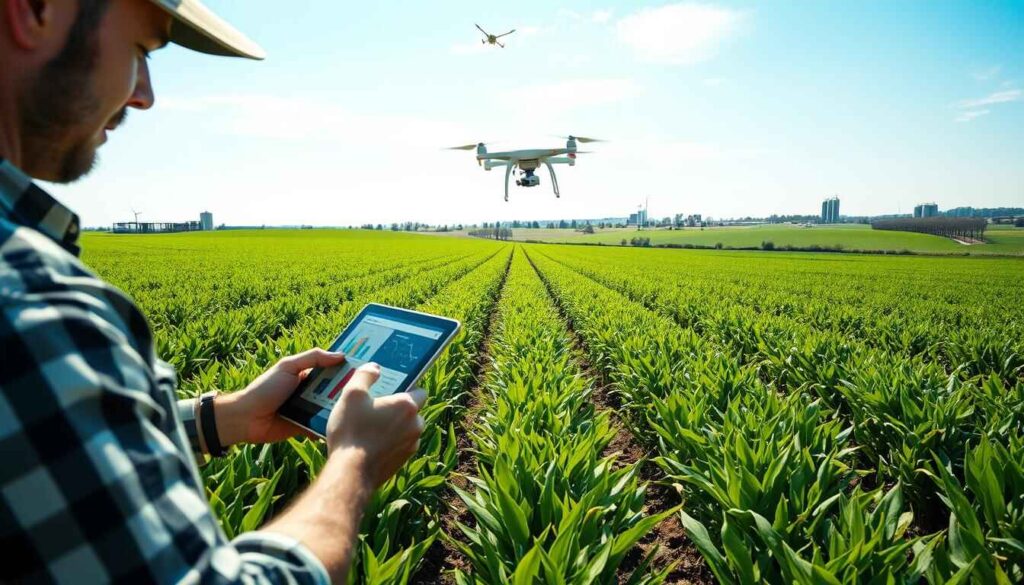

Can a tractor that thinks, sensors that learn, and software that predicts weather-linked yield truly change how you run your farm? This guide will show you how to use AI in Agriculture on your farm. You’ll learn about farming technology and smart farming solutions. It’s all designed for U.S. farmers, agribusiness managers, and extension agents.
Why is this important now? Rising costs, labor shortages, and changing weather make smart decisions key. With affordable sensors, easier drone and satellite access, cloud computing, and new analytics, you can use powerful tools on your farm.
In this article, you’ll find clear definitions and real-world examples. You’ll learn about precision agriculture, robotics, and hands-on tools you can use today. You’ll also discover sustainability wins, data collection tips, budget-friendly plans, and how to measure ROI.
Key Takeaways
- This guide focuses on practical, step-by-step adoption of farming technology for U.S. operations.
- AI in Agriculture helps tackle costs, labor gaps, and climate risk with predictive and automated tools.
- Advances in sensors, drones, and cloud services make agricultural artificial intelligence accessible now.
- You’ll learn both quick wins and long-term projects for smart farming solutions.
- The article emphasizes measurable ROI, training, and regulatory considerations to protect your farm data.
AI in Agriculture
AI in agriculture uses machine learning and other tech to make farming smarter. It turns data from sensors and satellites into useful advice. For example, it predicts harvest sizes and spots pests with drones.
AI changes farming by making decisions based on data, not just rules. It helps spot diseases early and decides when to water. This means you can have a quieter morning and respond faster to problems.
How AI differs from traditional farming technology
Old farming tech, like GPS tractors, just follows your plans. But AI adds a new layer by analyzing data in real time. It learns from past seasons and adjusts its advice as needed.
Primary benefits you can expect
- Higher yields thanks to better planning and treatments.
- Lower costs by using less fertilizer, water, and pesticides.
- Weather and pest resilience through early warnings.
- More efficient labor with automated tasks.
- Better traceability for quality-conscious markets.
| Area | Traditional Tech | Agricultural Artificial Intelligence |
|---|---|---|
| Decision-making | Fixed rules, human interpretation | Adaptive models that learn from field data |
| Data sources | Single systems like GPS or weather | Sensor networks, drones, satellites, and historical records |
| Operation | Task automation (plowing, planting) | Task automation plus optimized timing and rates |
| Economic impact | Labor savings and speed | Input cost reduction and yield uplift |
| Adaptability | Static settings per season | Continuous learning and seasonal improvement |
How Machine Learning in Farming Improves Crop Management
Machine learning in farming turns raw data into clear actions for your fields. It combines weather forecasts, soil tests, historical yields, and satellite imagery for field insights. These insights help decide planting dates, seed choices, and input timing, making decisions more confident.

Predictive analytics blend data to forecast yields. Systems like Climate Corporation, Granular, and IBM Watson create models. They consider weather, soil, and past harvests to guide planting and income estimates.
Computer vision systems warn about stress, disease, and pests early. Drone or camera images run through models by PlantVillage/Nuru, Taranis, and Prospera. This early detection improves accuracy and targets interventions, reducing pesticide use and saving money.
AI controls irrigation and fertilization based on crop needs. Soil moisture sensors and ET data feed models that adjust by zone. This variable-rate application boosts efficiency and supports sustainable farming.
| Use Case | Data Inputs | Real-World Providers | Direct Benefit to You |
|---|---|---|---|
| Yield forecasting | Weather forecasts, satellite imagery, soil tests, yield history | Climate Corporation-type models, Granular, IBM Watson Decision Platform for Agriculture | Better planting timing, marketing plans, and input budgeting |
| Disease & pest detection | Drone imagery, fixed cameras, labeled field photos | PlantVillage/Nuru research, Taranis, Prospera | Faster diagnosis, targeted sprays, lower chemical use |
| Irrigation & nutrient optimization | Soil moisture sensors, ET data, crop growth models | Smart irrigation controllers, precision fertigation systems | Higher input efficiency, water savings, improved yields |
Precision Agriculture: Getting the Most from Your Land
Boosting yields and cutting costs is possible with targeted, data-driven practices. Precision agriculture combines mapping, sensing, and machine intelligence. This ensures your decisions are based on field variability.
Actionable tools like prescription maps, soil diagnostics, and fused imagery guide your on-farm choices. These tools help make informed decisions.

Variable rate application explained
Variable rate application (VRA) adjusts seed, fertilizer, and pesticide delivery to local field conditions. AI creates prescription maps that mark management zones and suggest application rates. This raises returns per acre and cuts waste.
Most guidance systems on John Deere and AGCO equipment accept these prescriptions. This makes it easy to move from map to implementation with minimal rework.
Soil mapping and zonal management
Soil mapping starts with grid sampling and tools like EM38. These tools reveal texture, moisture, and compaction patterns. Machine learning clusters these measurements into management zones.
These zones predict where inputs will deliver the best return. You then set the sampling frequency and allocate inputs by zone. Picking field-specific crops improves profitability and soil health.
Satellite and drone data fusion for decision-making
Satellite and drone data fusion combines multispectral satellites like Sentinel-2 and Landsat with high-resolution drone imagery and ground sensors. AI stitches these streams, fills gaps, and flags areas for scouting, VRA updates, or adjusted harvest timing.
The fused view makes crop stress and variability easier to act upon across growing seasons.
Robotics in Agriculture: Automating Repetitive Tasks
Robotics in agriculture is changing how farms work. Both small and big farms use machines for repetitive tasks. This makes work more efficient and strategic.
Autonomous tractors and harvesters
Companies like John Deere and CNH Industrial have autonomous tractors. They use GPS and AI for tasks like planting and harvesting. This means you can work longer hours and at night.
Robotic weeding and seeding systems
Robots from Naïo Technologies and Blue River Technology can spot weeds. They remove weeds or spray them with precision. This reduces herbicide use and protects crops.
Labor savings and safety improvements
Using robots in agriculture saves a lot of labor. You need fewer workers and work less. This also means fewer injuries from repetitive tasks.
Robots make working at night and in dangerous conditions safer. They reduce exposure to dust and chemicals. Make sure to plan for battery life and maintenance for the best results.
AI Crop Management Tools You Can Use Today
Smart tools make it easier for you to adopt ai crop management on any size operation. Below are practical options, integration tips, and real U.S. examples. These show measurable outcomes when integrating farming technology into daily workflows.
Mobile apps and cloud platforms for small and large farms
For mobile apps for farming, check out Farmers Edge, Granular, Climate FieldView, CropX, AgroStar, and DroneDeploy. These platforms offer field mapping, real-time alerts, advisory modules, and seamless sync with farm management software.
Farmers Edge and Granular give robust operational dashboards for acreage planning. Climate FieldView focuses on telemetry and yield analytics. CropX adds soil sensing and irrigation guidance. AgroStar supplies localized advisory content. DroneDeploy supports aerial scouting and image analytics for quick decisions.
Choosing tools that integrate with existing equipment
When selecting tools, check compatibility with ISOBUS, John Deere Operations Center, and AgGateway standards. Verify data export formats, API access, and whether a platform supports both small plots and large operations.
Trial cloud demos and confirm cellular or satellite connectivity for remote fields. Test data flows between your equipment and the cloud. This ensures smooth integration of farming technology without disrupting routines.
Case studies of farms that adopted AI crop management
A Midwest corn and soybean operation used precision nitrogen maps from Climate FieldView and Granular analytics. They cut fertilizer spending by 18% while holding yield steady. The maps guided variable-rate application and reduced overlap on passes.
In California, a vegetable grower combined DroneDeploy scouting with a CropX irrigation plan and AI-driven disease alerts. Fungicide use dropped by 22% and scouting time fell by half. This saved labor costs and lowered chemical inputs.
You can replicate these gains by pairing mobile apps for farming with cloud platforms that match your gear and scale. Start with short pilots, track input costs and yield, and expand tools that prove value on your farm.
Sustainable Farming Practices Enabled by Smart Farming Solutions

Smart farming solutions make sustainability easy on your land. They connect data to actions that cut waste, save fuel, and help soil recover. Start small and grow what works for you.
AI-driven irrigation and variable-rate nutrient apps reduce runoff and leaching. Tools like CropX and AquaSpy check soil moisture and conditions. This way, you apply water and fertilizer where the crops need it most, saving water and maintaining high yields.
Autonomous machinery and smart input timing cut down on fuel use. Pairing autonomous tractors with precise application lowers the carbon footprint. Practices like cover crops and reduced tillage become more appealing when AI shows their benefits.
Sensor networks and aerial imaging let you monitor soil health constantly. You can track organic matter, cover crop success, and pollinator habitats over time. This data helps you adjust rotations and conservation practices for better biodiversity and sustainability.
The table below compares key smart farming tools and the sustainability gains you can expect on a typical mid-sized U.S. farm.
| Tool / Practice | Primary Function | Sustainability Benefit | Typical Impact |
|---|---|---|---|
| CropX | Soil sensing and irrigation scheduling | Reduces water use and prevents nutrient leaching | 10–30% lower irrigation volume, improved water-use efficiency |
| AquaSpy | Root-zone moisture monitoring | Supports targeted irrigation, reducing runoff | Reduced water waste and healthier root systems |
| Autonomous tractors | Reduced-pass field operations | Lower fuel consumption and fewer emissions | 15–40% fewer field passes, lower carbon footprint |
| Cover crop planning with AI | Optimizes species and timing | Improves soil structure and biodiversity | Higher soil organic matter, better resilience |
| Drone and sensor networks | Aerial imaging and in-field monitoring | Enables real-time soil health monitoring and habitat checks | Faster detection of issues, informed conservation moves |
Data Collection: Sensors, Drones, and IoT on the Farm
Data is key to making smart choices on your farm. First, figure out what you need to track. Then, pick the right sensors for those tasks. Make sure your field gear and internet work well so you get your data on time.
What sensors you should consider installing
Get a variety of devices to monitor soil, weather, and crops. Soil moisture probes and soil temperature sensors, and also weather stations are good starts. Also, think about crop canopy sensors, pH/EC sensors, and flow meters.
Put sensors in key spots in your fields. Make sure they’re set up right before using them. Keep up with maintenance: check after rain, clean them seasonally, and change batteries often.
Drone imaging: multispectral and thermal uses
Drone imaging with multispectral and thermal tools can find problems early. Multispectral sensors show plant health and nutrient levels. Thermal cameras spot water stress and leaks in irrigation.
Use RGB cameras for regular checks and to see how crops are growing. Follow FAA rules for flying drones for work in the U.S. Plan your flights based on the crop’s stage and repeat them often to see changes.
Managing and securing farm data streams
Think about how you’ll connect your devices first. You can use cellular, LoRaWAN, or satellite links. Pick what fits your farm and budget.
Choose cloud storage with backups and use common formats like ISO and AgGateway. For security, use strong passwords and encrypted data. Read agreements carefully to know who owns your data and how it’s shared.
Implementing AI on a Budget: Practical Tips for Farmers
You can make your farm smarter without spending a lot. Start by setting clear goals and choosing simple, cost-effective solutions. This way, you can use AI on a budget, even if you’re a small or mid-size farm.
First, focus on farming tech that gives you quick wins. Tools like low-cost soil moisture sensors and affordable crop management apps can save you money. They also help increase your yields. Always compare the costs and benefits to see which investments are worth it.
Begin with small pilot projects to try out new tools. Use A/B test strips to compare old methods with new ones. Keep these tests small, around 5–10 acres, to get clear results. It might take 1–2 seasons to see real changes in your crops.
Implementing tech in phases is safer. Start with sensors and analytics, then add automation later. Track how these changes affect your labor, inputs, and yields. Only scale up what works well for your farm.
There are many ways to fund your tech upgrades. Look into USDA programs like NRCS and EQIP for help with irrigation and sensors. State programs might offer matching funds for equipment. Grants from SARE can support on-farm trials.
Explore financing options like low-interest loans from the Farm Service Agency. You can also look into vendor financing, leasing, or equipment-as-a-service. Compare the total costs over time to find the best option for your budget.
Below is a compact comparison to help you weigh first-step choices, pilot design, and funding sources.
| Priority | Typical Cost Range | Pilot Design | Funding & Financing |
|---|---|---|---|
| Soil moisture sensors | $200–$1,500 per zone | Install in 2–4 zones; compare irrigation cycles | EQIP, state cost-share, vendor leasing |
| Subscription crop apps (analytics) | $300–$2,000 per year | Run one field with app, one without; monitor yields | SARE grants, small operating loans, vendor trials |
| Spot-spray weed tech | $5,000–$25,000 | Test on 5–10 acres; measure herbicide use reduction | FSA low-interest loans, leasing, equipment-as-a-service |
| Drone imaging (multispectral) | $1,500–$15,000 | Weekly flights over pilot plot for two seasons | State grants, vendor financing, contract scouting |
Regulatory and Ethical Considerations for Agricultural Artificial Intelligence
Before you start using smart tools on your farm, think ahead. This guide will help you understand the legal and ethical sides. It covers how to protect your data, spot AI that’s not clear, and follow U.S. rules for drones, runoff, and pesticides.
Data ownership and farmer privacy
Read the terms of service from vendors before they collect data from your farm. Look out for clauses that give them rights to your data or allow sharing. Keep your own copies of raw data to keep control over your farm’s records.
Talk about data-sharing terms when you can. Ask for limits on who can access your data and ensure your fields won’t be identified. Choose platforms that are clear about privacy and keep your data safe.
AI transparency and algorithmic bias risks
Models that are not clear can make choices based on where they were trained. A model from the Midwest might not work well in California. Be careful when using tools in different places.
Look for vendors that explain their models and offer reports. Ask for details on how they were trained and tested. Clear tools help you check their advice and avoid mistakes.
Compliance with U.S. agricultural and environmental regulations
Drones for imaging must follow FAA rules, like Part 107 for pilots. Keep records of flights and waivers for special cases.
Using pesticides must follow EPA labels and state laws. Check the labels and keep records of when you spray. Controls for runoff can affect waterways, so document your efforts to meet standards.
If you’re unsure, ask your county extension office or a lawyer. Keep good records, update your procedures, and train your team. This will help you follow U.S. rules and protect your data and privacy.
| Area | Risk | Practical steps |
|---|---|---|
| Data ownership | Vendors claiming rights to imagery or models | Retain raw data, negotiate contract terms, require limited licensing |
| Farmer privacy | Unintended sharing of field-level identifiers | Anonymize records, set access controls, choose platforms with strong privacy policies |
| AI transparency | Opaque recommendations and regional bias | Request explainability, demand validation, retrain models on local data |
| Drone operations | FAA noncompliance and fines | Follow Part 107, keep logs, obtain waivers for special flights |
| Pesticide and runoff | EPA and state violations, Clean Water Act exposure | Follow labels, record applications, document runoff mitigation |
| Recordkeeping | Insufficient proof of compliance | Maintain clear logs, update SOPs, train staff regularly |
Training Your Team and Bridging the Skills Gap
You need a clear plan to bring smart tools into daily farm work. Start with hands-on learning that fits your operation. Practical sessions cut downtime and build confidence fast.
On-farm training programs and workshops
Run on-farm training programs that pair vendor demos with repeat practice. Teach sensor upkeep, basic drone flights under FAA Part 107 rules, and reading platform dashboards. Create simple SOPs so workers follow the same tech workflow every time.
Use short modules so learning happens during regular shifts. A half-day workshop on sensor checks followed by a field drill keeps skills fresh without hitting your harvest window.
Partnering with universities and extension services
Tap land-grant university extension services and the USDA cooperative extension for region-specific guidance. University partnerships can offer field trials, calibrated protocols, and training modules tailored to local soils and pests.
These partners often run workshops, host demonstration plots, and lend technical assistance. You get proven methods and evidence from research, not just product pitches.
Hiring vs. upskilling existing staff
Decide based on budget, scale, and technical depth required. Upskilling farm staff boosts morale and speeds adoption when tasks are operational. Bring in specialists when you need advanced data analysis or custom integration work.
Consider a hybrid model: upskill crew for daily tasks while contracting a data scientist or remote consultant for seasonal analytics. That balances cost with capability.
| Need | Best Approach | Why it works |
|---|---|---|
| Routine sensor checks and drone flights | On-farm training programs | Hands-on practice builds reliable, repeatable workflows |
| Region-specific best practices | University partnerships | Access to extension resources and field-validated research |
| Advanced analytics and model tuning | Hiring for precision agriculture | Specialists deliver complex data skills and custom solutions |
| Long-term staff retention and adoption | Upskilling farm staff | Investing in people improves retention and lowers turnover |
| Seasonal or one-off projects | Remote consultants or short hires | Flexible expertise without long-term payroll costs |
Mix on-farm training programs with university partnerships for a practical, research-backed approach. Plan when to focus on upskilling farm staff and when to prioritize hiring for precision agriculture to meet your goals.
Measuring ROI: How to Track the Success of Farming Technology
Before you start using farming technology, make a plan to measure its ROI. Set clear goals and choose metrics to track. Keep records regularly. A small pilot can show the technology’s impact without risking everything.
Key performance indicators for AI deployments
Choose KPIs that match your farm’s goals. Track yield, input costs, labor, fuel, and harvest quality. Also, monitor environmental factors like nitrogen runoff and soil health.
Include financial metrics like profit, payback period, and ROI. Use a dashboard to easily compare trends.
Collecting baseline data and running controlled trials
Get baseline data for a full season before adding new tools. This baseline helps set realistic expectations.
Design controlled trials with randomized strips or paired fields. Keep everything the same except for the technology being tested. Use farm management software for consistent records.
Interpreting results to scale or pivot strategies
Learn about statistical significance to know if changes are real. Scale when improvements meet your break-even points. Iterate on treatments and renegotiate contracts if savings are worth it.
Document lessons learned for wider adoption. Clear records and careful analysis lead to confident scaling decisions.
Conclusion
To see real results from AI in farming, start by learning the basics and doing small tests. Choose high-impact tech that fits your farm, like sensors, drones, or apps. It’s also key to collect data to measure changes.
When testing, set clear goals and track your progress in yield, inputs, and costs. This helps you see how things are improving.
Next, take practical steps: check your current gear and data flow, pick a pilot project that fits your budget, and look for funding. USDA programs and state grants can help. Work with vendors and local experts for training to make your team ready for new tech.
Start with small steps in precision and sustainable farming to lower risks and learn faster. Keep up with new tech, better satellite data, and open data to stay ahead. Begin small, test quickly, and grow what succeeds to make your farm more productive and sustainable.
FAQ
What does “AI in Agriculture” mean for my farm?
AI in agriculture uses advanced tech to help you make better decisions and automate tasks. It can predict yields, detect pests, and control irrigation. These tools turn data into actionable advice, helping you increase yields and save costs.
How is agricultural artificial intelligence different from the farm technology you already use?
Traditional farm tech does what you tell it to do. AI, on the other hand, analyzes data in real time and learns from it. This means it can adjust its actions based on what it finds, making your farm more efficient.
Which machine learning uses will give me the biggest crop management gains?
Predictive analytics, automated disease detection, and smart irrigation are key. They help you plan better, spot problems early, and use resources wisely. This leads to better yields and lower costs.
What are practical precision agriculture tools I can adopt now?
Start with apps and platforms like Farmers Edge and Granular. They work for any farm size. Try out soil sensors, apps, or drone services to see what works best for you.
How do variable-rate application and soil mapping work for improving returns?
Variable-rate application uses maps to apply inputs where needed most. Soil mapping helps create zones for better management. This reduces waste and boosts profits.
Are agricultural robots reliable enough to replace manual labor?
Robots can help a lot, but they don’t replace humans yet. Look at systems from John Deere and Blue River Technology. Start small to see how they fit into your workflow.
How can AI help me farm more sustainably?
AI helps by using less water and fertilizer. It also cuts down on fuel use and emissions. Sensors and drones help monitor the environment, supporting biodiversity.
What sensors and drone capabilities should I invest in first?
Start with soil moisture probes and a weather station. For imaging, drones with multispectral and thermal cameras are best. Choose tools that answer your biggest questions and are easy to maintain.
I have a limited budget — how should I implement AI affordably?
Focus on tools with high ROI, like soil sensors and advisory apps. Run small pilots first. Look into USDA programs and vendor financing to help with costs.
Who owns the data collected by AI platforms, and how do I protect my farm’s privacy?
Data ownership varies by platform. Always check the terms and negotiate data use. Keep your raw data safe and choose vendors with strong privacy policies.
Can AI recommendations be biased or wrong for my region?
Yes, models may not work well in your area. Look for vendors that offer local validation and model explainability. Run your own trials to check their effectiveness.
What regulations should I be aware of when using drones, pesticides, or autonomous machines?
Follow FAA rules for drones and local laws for pesticides and autonomous machines. Make sure you’re compliant with environmental regulations too.
How do I train my team to use AI tools effectively?
Use workshops and training from vendors and extension services. Teach your team about sensors, drones, and dashboards. Hire experts or consultants for complex tasks.
Which KPIs should I track to measure the ROI of AI on my farm?
Track yield, quality, environmental metrics, and financial data. Collect baseline data and use trials to measure impact. This helps you see the benefits of AI.
How long before I see measurable benefits from an AI pilot?
Expect to run pilots for one to two seasons. Some benefits, like pest detection, may show quickly. Others, like yield and ROI, take longer to validate.
Will AI in Agriculture remain useful long-term?
Absolutely. While the AI bubble may cause market hype, practical AI technologies that improve efficiency, sustainability, and yields are here to stay.
What smart farming tools have you used? Let us know your thoughts in the comments! And don’t forget to read our previous article
Why AI in Plant Science is the Key to Sustainable Agriculture
Top 7 Organic Flower Farming Techniques to Boost Flower Yield
Organic Flower Farming in North America: How Sustainability Is Taking Root
How a Flower Turns Into Fruit: Simple Science Explained for You


Pingback: How AI Crypto Trading Can Predict Market Trends
Pingback: The Secret Role of AI in Flower Growth
Pingback: The Role of AI in Climate Change: What You Should Know
Pingback: The Ultimate List of 10 AI Tools for Business Success
Pingback: The Future of AI for Teachers in USA Classrooms in 2026
Pingback: Screenless AI Explained: Features, Benefits, and What’s Coming in 2026
Pingback: How a Smart City Traffic Management System Can Transform Urban Travel in 2026