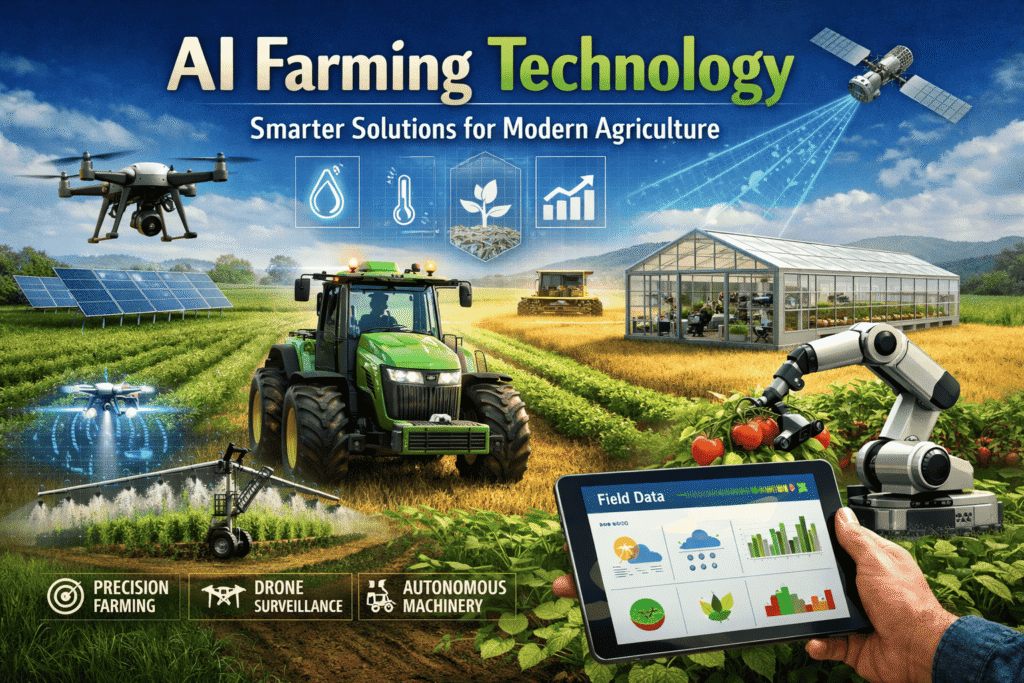

You may remember a season when weather changes, labor shortages, or a small budget decided your harvest. Watching your crops struggle and hoping for better answers is exactly why AI Farming Technology matters today. You need smart and practical ways to protect your yield and plan with confidence.
In this guide, you will learn what AI Farming Technology means in agriculture and why it is important for your farm right now. You will see easy-to-understand explanations of how data and smart tools—such as driverless tractors, sensors, and greenhouse robots—help you manage limited water, changing weather patterns, and labor gaps more effectively.
This brief introduction highlights the potential impact on fieldwork, post-harvest choices, and business decisions. It also points you to the first tools to evaluate based on your crops and region. By the end, you’ll see how intelligence and information flow from sensors into decisions that improve outcomes for farmers.
Key Takeaways
- Understand what artificial intelligence means in agriculture and why it matters to you.
- See how data and tools reduce waste and close labor gaps.
- Identify the first systems to test for your fields and crops.
- Learn how information from sensors turns into actionable insight.
- Preview the future role of intelligence-driven systems on your farm.
Why AI Matters in Modern U.S. Agriculture Today
U.S. farms face a tight squeeze: rising demand for food meets shrinking resources and more volatile weather. By mid-century, you may need to produce nearly 70% more food, yet land, labor, and water are more constrained than before.
Feeding a Growing Population Under Climate and Resource Constraints
Water and weather now shape daily decisions on your farm. Smart systems turn scattered observations into clear insights so you can time sowing, irrigation, and harvest more effectively.
That shift helps you protect yield when windows for fieldwork are short. It also reduces waste—less water is applied and fewer unnecessary passes across fields.
From Traditional Methods to a Data-Driven Farming Revolution
Instead of relying on averages and manual scouting, you can use data and machine learning to make zone-specific recommendations. This raises productivity by matching inputs to crop needs at the right place and time.
- Turn weather, soil, and market signals into one source of truth for local decisions.
- Evaluate trade-offs: where to irrigate, when to fertilize, and how to respond to weather windows.
- Deploy practical use cases now—smarter irrigation scheduling and targeted pesticide applications that cut costs and risk.
For farmers, the role of this approach is clear: keep control while automating routine tasks, reduce waste, and improve timing and compliance across the operation.
AI Farming Technology: Benefits and Business Impact
When you turn field, market, and weather readings into clear actions, costs fall and yields rise. This section shows practical business gains you can expect and how to start measuring return on your investment.
Data-Driven Decisions: Turning Field, Weather, and Market Data into Actionable Insights
Operational choices become simpler when you combine soil probes, weather forecasts, and price signals. Predictive analytics help you pick optimal sowing and harvest windows and forecast market shifts.
This reduces wasted passes and improves timing, so your team makes fewer reactive moves and more planned ones.
Precision and Cost Savings: More Yield with Less Water, Inputs, and Labor
Precision strategies apply inputs where they matter. Variable-rate seeding and fertilizing lift productivity while cutting chemical and fuel costs.
- Higher productivity and targeted applications that protect yields.
- Smart irrigation that cuts water waste and energy use.
- Solutions that let you start small and scale after proving ROI.
Automation Advantage: Smart Irrigation, Autonomous Machinery, and Greenhouse Robots
Automated machines and smart irrigation systems lower labor needs and improve consistency. Fewer field passes mean savings on fuel and time.
| Benefit | Example | Business Impact |
|---|---|---|
| Efficiency | Driverless tractors | Lower labor cost, faster work |
| Water savings | Leak detection + smart irrigation | Less water use, lower energy bills |
| Quality | Post-harvest sorting | Higher pack-out, better market prices |
What you gain: clearer daily decisions, measurable savings, and systems that learn from your operation. Farmers who apply these approaches report steady productivity and an improved business impact season after season.
Core Applications You Can Deploy Now
Practical tools now on the market help you spot threats and act faster across every field.
Crop disease detection uses computer vision and machine learning on field images to flag issues early. Systems report ~95% accuracy for apple scab and can spot yellow rust in wheat, so you can treat outbreaks before they spread.
Targeted weed control and spraying
See & Spray platforms and robots from John Deere, Naïo, and ecoRobotix distinguish weeds from crop rows. That lowers herbicide use by as much as 90% and protects your yield.
Irrigation, soil sensing, and leak detection
Sensors from vendors like Arable and CropX feed soil and weather data to refine irrigation schedules. Models also detect leaks by spotting odd flow or pressure patterns to save water fast.
Drones, livestock, yield and post‑harvest tools
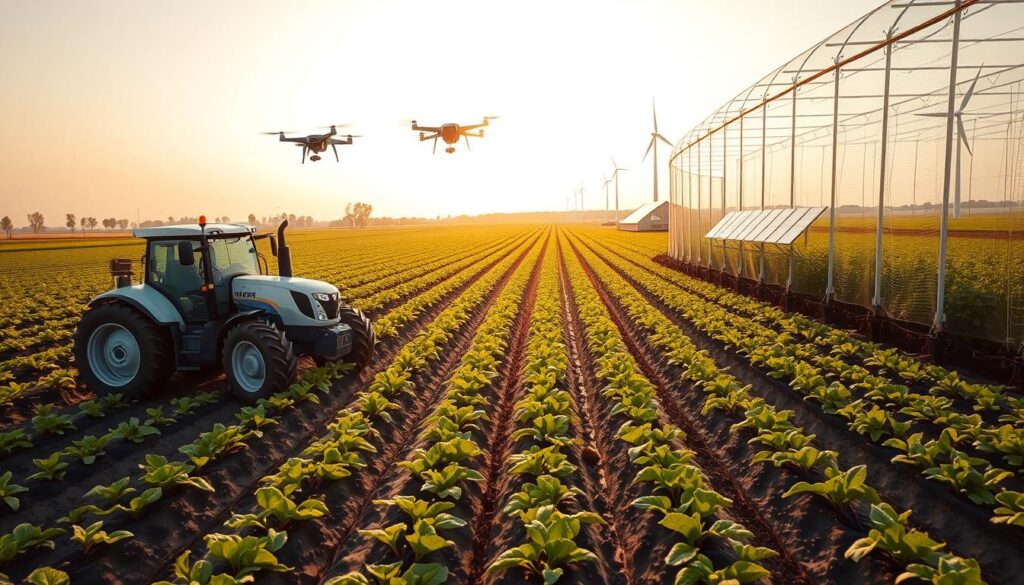
Drones speed up monitoring and enable on‑demand spraying with precise maps. CattleEye monitors herd health and behavior with cameras to flag lameness or calving issues early.
- Yield mapping combines drone and sensor data to predict outcomes and tune planting and inputs.
- Post‑harvest sorting uses computer vision to grade size, color, and defects at scale.
- Supply chain forecasting improves timing and reduces waste, as seen with AgriDigital-style transaction optimization.
Choose systems that match your crops and fields, start with quick wins, and build a roadmap that scales across your operation.
The Technology Stack Powering AI in Agriculture
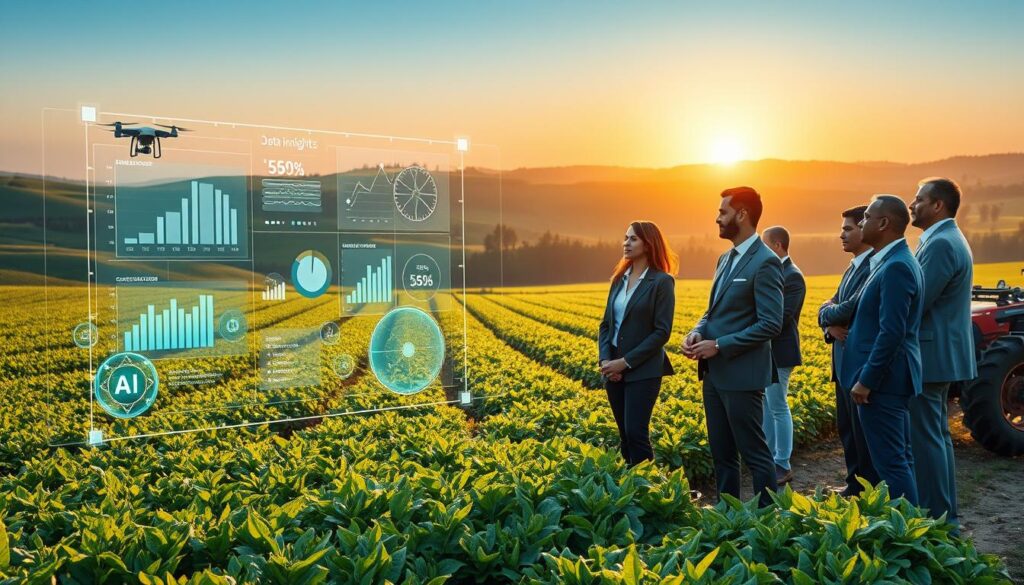
Begin with the data path: sensors in the field, gateways on the edge, and cloud models that deliver timely recommendations. This stack turns raw readings into usable information you can act on fast.
IoT Sensors and Field Telemetry: Soil Moisture, Weather, and Crop Health
Sensors collect soil moisture, temperature, and microclimate readings. You place probes and weather stations across zones to capture variation by field.
Choose sensors for battery life, calibration ease, and compatibility with your on‑farm systems. Good density and proper placement matter more than sheer sensor count.
Big Data Pipelines and Models: From Collection to Real-Time Insights
Edge gateways aggregate local readings and push them to cloud platforms. Big data platforms clean, store, and serve that data to models in near real time.
Machine learning fuses weather, soil, and market feeds to generate recommendations. Plan for data governance, quality checks, and feedback loops so models improve with time.
Computer Vision, Drones, and Satellite Imagery for Field-Scale Monitoring
Field monitoring blends computer vision from ground cameras and drones with satellite imagery to spot stress, disease, or nutrient gaps. Each method balances cost, resolution, and revisit time.
Intelligent Automation and Robotics: From Weeding to Harvesting
Robotic implements embed intelligence to guide weeding, targeted spraying, and automated picking. They reduce labor needs and improve repeatability for routine tasks.
Evaluate systems for reliability, updates, and compatibility with your tractors and records. Look for clear audit trails and simple interfaces so your crew adopts tools quickly.
| Monitoring Method | Resolution | Cost | Best Use |
|---|---|---|---|
| Ground cameras + computer vision | High (plant level) | Moderate | Early disease and pest spotting |
| Drones | Very high (field passes) | Moderate–High | Targeted surveys and NDVI maps |
| Satellite imagery | Medium (field to sub-field) | Low–Moderate | Large area trend monitoring |
Adoption Challenges and How You Overcome Them
Putting new systems into your operation requires a clear plan. Upfront costs, staff readiness, and secure handling of data are the main hurdles. You can overcome them with staged pilots and practical funding plans.
Upfront Costs, ROI Planning, and Funding Options
Start with a tight ROI plan that prioritizes quick wins. Seek grants, lease options, or partnerships to lower capital needs.
- Choose targeted solutions that plug into existing systems to reduce risk.
- Sequence purchases so early successes fund later phases.
- Review vendor support terms for updates and field service.
Skills, Training, and Change Management for Your Team
Train your crew with short, hands‑on sessions and simple interfaces. Define roles, success metrics, and feedback loops so adoption sticks across seasons.
Data Privacy, Security, and Infrastructure Readiness
Set data standards and governance to improve quality and ownership. Harden security with access controls, encryption, and backups.
Assess connectivity and plan network upgrades to ensure reliable use and timely information flow.
| Challenge | Action | Near‑term Benefit |
|---|---|---|
| High upfront cost | Phased purchases + grants | Lower financial risk, early ROI |
| Staff unfamiliarity | Hands‑on training, pilot teams | Faster adoption, fewer errors |
| Poor data quality | Standards, governance, audits | Better model accuracy, clearer insights |
| Weak connectivity | Network upgrades, edge caching | Reliable system uptime and use |
Conclusion
Proof of value often begins with a single season of focused monitoring and action. Use artificial intelligence and machine learning where they solve a clear problem. Start small and measure gains so decisions rest on real data and results.
Prioritize tools that protect crop health: targeted irrigation, soil moisture analytics, drones, satellite imagery, and computer vision for fast disease detection. These approaches save water and inputs while improving soil care and yields.
Plan phased adoption so systems integrate with your crew and records. With the right steps you strengthen supply chain timing, boost productivity, and position your farm for long‑term growth and resilience in U.S. agriculture.
FAQ
What is the core purpose of AI farming systems for modern agricultural needs?
The core purpose is to help you make faster, clearer decisions using data from soil sensors, satellite imagery, drones, and weather services. These systems turn raw measurements into actionable guidance on irrigation, nutrient management, pest control, and harvest timing so you can raise yields, cut input costs, and reduce waste.
Why does intelligent data matter for U.S. agriculture today?
Data matters because you face tighter margins, shifting weather patterns, and rising demand. By using field telemetry, machine learning models, and supply-chain analytics, you can adapt planting windows, optimize water and fertilizer use, and forecast market needs to protect profitability and resilience.
How do field sensors and telemetry improve crop decisions?
Soil moisture probes, weather stations, and plant health sensors provide real-time signals you can act on. They let you schedule irrigation precisely, detect nutrient stress early, and avoid blanket treatments—reducing water use, lowering chemical inputs, and improving crop health.
What practical benefits will you see from precision systems on your farm?
You will typically see higher yields per acre, lower water and input costs, and reduced labor through automation. Precision tools let you apply seed, fertilizer, and spray only where needed, which increases productivity while cutting emissions and input waste.
Can you deploy disease and pest detection tools now, and how accurate are they?
Yes, scalable computer vision models and aerial imagery already detect common issues like apple scab or yellow rust. Accuracy varies with image quality and training data, but many growers reach reliable early-warning detection that enables targeted, timely treatments.
What weed-control automation options exist and who makes them?
See & Spray systems, robotic platforms such as ecoRobotix and Naïo, and camera-guided applicators let you target weeds precisely. These systems lower herbicide use and hand weeding, saving labor while protecting crop yields.
How do drones and satellite imagery work together for monitoring?
Satellites deliver frequent, field-scale coverage for trend detection while drones provide high-resolution, on-demand views for problem spots. Together they give you a layered monitoring approach: broad surveillance plus targeted inspection and intervention.
What role does automated irrigation and leak detection play in water management?
Automated systems combine soil moisture data and short-term weather forecasts to schedule irrigation efficiently. Leak detection uses flow meters and anomaly detection to spot system failures early, saving water and avoiding crop stress.
How can predictive yield mapping and analytics help your planting and input choices?
Predictive models use historic yields, soil maps, and in-season data to forecast field outcomes. That lets you choose seed varieties, place inputs strategically, and set realistic harvest plans to maximize return on investment.
Are there ready solutions for post-harvest sorting and quality grading?
Yes. Vision-based sorting lines and conveyor systems automate quality grading for fruit, grain, and produce. They speed processing, improve pack-out rates, and ensure consistent standards for buyers and retailers.
What technology stack will you need to run these systems?
Expect a mix of edge sensors, connectivity (cellular or LoRaWAN), cloud data pipelines, machine learning models, and user dashboards. Computer vision, drones, and satellite feeds integrate with farm management platforms for real-time insights and automation.
How do you manage upfront costs and measure ROI for these solutions?
Start with pilot projects on representative fields, track key metrics (yield, input use, labor), and calculate break-even based on savings and revenue gains. Leasing, grants, and EPA or USDA programs can offset capital costs while you validate performance.
What training and change management will your team need?
Provide hands-on training for field staff, pair new tools with familiar workflows, and assign a data champion to interpret insights. Clear SOPs and phased rollouts reduce resistance and help teams adopt automated routines effectively.
How is data privacy and security handled in farm systems?
Choose vendors with strong encryption, role-based access, and clear data ownership policies. Use secure gateways for telemetry, keep firmware updated, and review contracts to ensure you retain control over your farm data and who can access it.
How do supply-chain visibility tools reduce post-harvest waste?
Traceability platforms and demand-forecasting models align harvest and distribution with market needs. They minimize overproduction, optimize storage and routing, and reduce spoilage by matching supply to real-time demand signals.
Which vendors and tools should you evaluate first?
Start with reputable farm management systems and hardware providers that offer open integrations—companies such as John Deere, Trimble, Climate FieldView, and Conservis provide proven telemetry and analytics options. Evaluate local dealers and agronomy partners for tailored support.
Also Read This:-
- 12 Key Benefits of AI in Agriculture and Smart Farming Practices
- How a Smart Gardening System Can Turn You Into a Pro Gardener
- The Future of AI for Teachers in USA Classrooms in 2026
- What Is an AI Soil Sensor and How Does It Help Your Garden?
- The Role of AI in Climate Change: What You Should Know
- How AI in Photography Is Changing the Way We Capture and Edit Photos



Pingback: Underwater Flowers in the Ocean: Beautiful Marine Plants