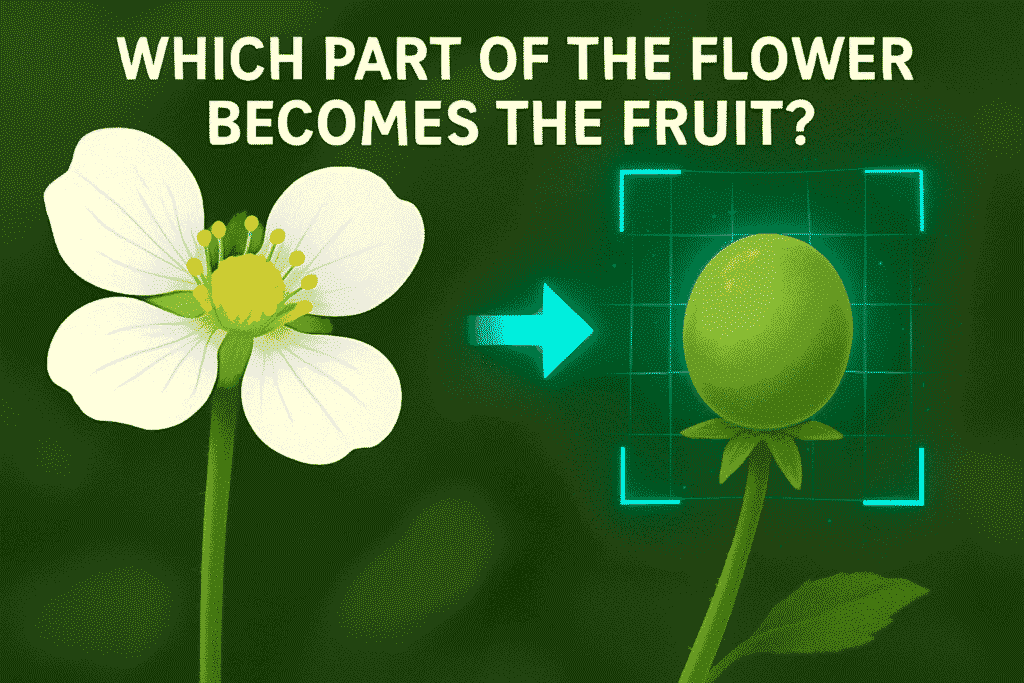

You want clear, usable information about how a blossom turns into a ripe fruit on your plant. This brief introduction explains the structure that ripens after double fertilization and why ovules develop into seeds while the ovary matures into a protective fruit.
You’ll learn how petals fall and the ovary swells, how environmental stress can stop development, and how simple, aggregate, multiple, and accessory fruits differ — giving you a clear, practical answer to which part of the flower becomes the fruit so you can spot normal growth in tomatoes, raspberries, or apples.
You’ll also see how modern AI reads those same visible cues — size change, color shift, and drop of floral parts — to flag fruit set in field and garden images. Use this guide to judge early signs, avoid false alarms, and time care like watering and pest control with confidence.
Key Takeaways
- The ovary in a blossom usually becomes the fruit after fertilization.
- Ovules mature into seeds while the ovary wall forms layers that protect them.
- Not all fertilized ovaries make fruits; stress or lack of resources can cause abortion.
- Fruit types—simple, aggregate, multiple, accessory—help you identify common garden examples.
- AI detects fruit set by tracking visible changes you can learn to spot yourself.
Which Part of the Flower Becomes the Fruit?
The journey from pollinated blossom to swollen fruit begins deep inside the ovary at the flower base.
Locate the pistil: you will see the stigma on top, the style below it, and the ovary at the base. That ovary holds the ovules that will become seeds after fertilization.
When pollen lands on the stigma and germinates, a tube travels through the style into the ovary. Double fertilization follows and triggers growth.
The ovary wall then differentiates into a layered pericarp: exocarp, mesocarp, and endocarp. Those walls form the protective tissues of the fruit while the ovules form seeds.
Ovary position matters. A superior ovary sits above petals and sepals, an inferior ovary lies below, and a half-inferior is in between. This affects where young fruits appear on your plant.
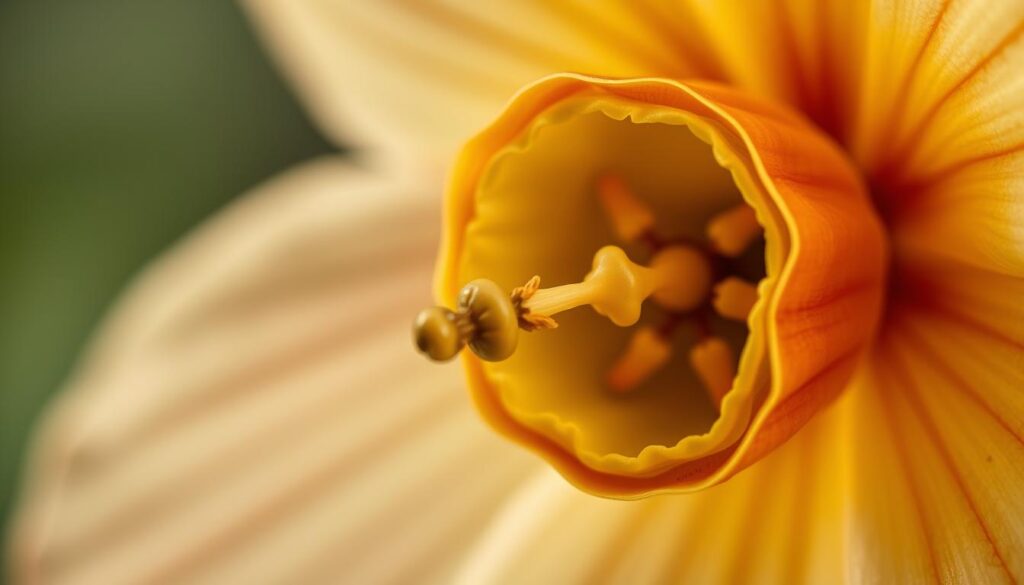
- Petals and sepals often wither as the ovary enlarges.
- Not every fertilized ovary matures—stress or competition can stop development.
How to Identify Fruit Formation on a Flowering Plant
A practical way to watch fruit develop is to check the pistil and note visible pollen and ovary changes. Start each inspection with a close look at the stigma, the slender style, and the swollen ovary at the flower base.
Locate the key parts
Find the sticky stigma on top, then the style, and finally the ovary where ovules sit. Use a hand lens if needed to see pollen grains on the stigma.
Confirm pollination and fertilization
Visible pollen on the stigma and spent anthers tells you pollination likely occurred. Pollen tubes travel down the style to cause fertilization, which starts seed formation.
Watch for swelling and setbacks
After fertilization, the ovary swells as ovules become seeds, and the wall forms pericarp. If petals and sepals fall and the ovary gains steady size and healthy color, early fruit set is happening.
Shriveling, discoloration, or stalled growth signals aborted ovaries. Heat, drought, or poor nutrition often trigger that outcome, so record dates and conditions to improve care.
- Quick check: pollen on stigma, anthers spent, and steady ovary growth mean good progress.
- Warning signs: arrested growth, browning, or shriveling suggest poor conditions.
| Stage | Visible signs | What to do |
|---|---|---|
| Pollination | Pollen on stigma; fresh anthers | Monitor daily; wait for ovary swelling |
| Early fruit set | Ovary enlarges; petals drop | Maintain water and nutrients |
| Abortion risk | Shriveled ovary; discoloration | Reduce stress; adjust irrigation |
| Seed formation | Firm ovary; internal ovules developing | Keep steady care until fruit matures |
Understand Fruit Types to Spot Development Accurately
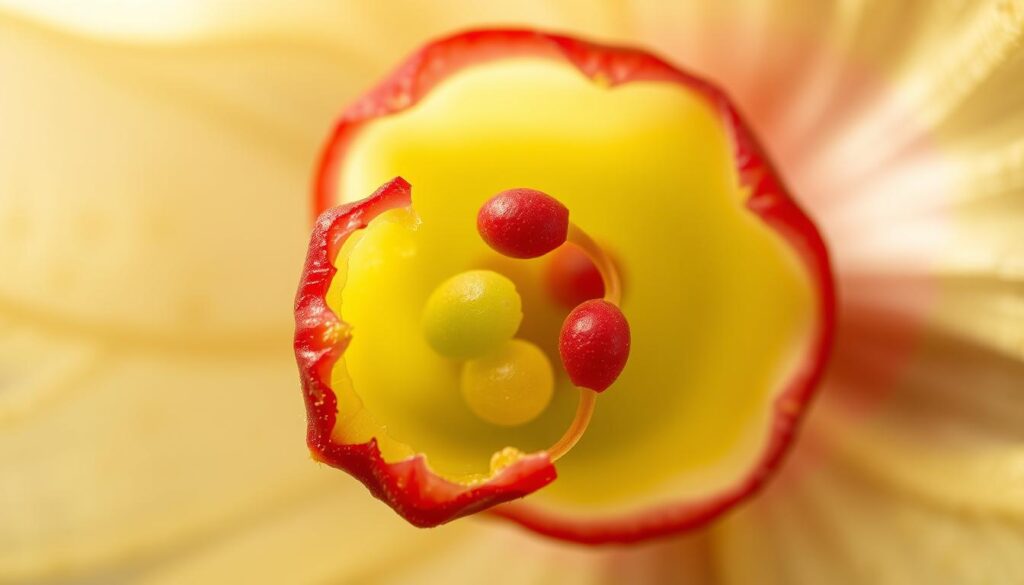
Recognizing fruit categories helps you read growth cues and avoid misidentifying normal changes on your plant.
Simple fruits come from one ovary of a single flower. Examples include oranges and many beans. In a simple fruit, one ovary differentiates into layers of pericarp as seeds form after fertilization.
Simple fruits and pericarp
Use oranges as a clear example: the hesperidium shows a distinct exocarp, mesocarp, and endocarp as it matures. That layered structure explains skin, pith, and segments you see.
Aggregate and multiple forms
Aggregate fruits, like raspberries, arise when many ovaries from one flower each form a small drupelet. Each tiny unit holds its own seed.
Multiple fruits, such as pineapples, form when many flowers in an inflorescence fuse into a single mass with repeated surface units.
Accessory fruits and seed release
Apples are accessory fruits: extra floral tissue adds to the edible part, while the true ovary becomes the core with seeds. Some fruits are dehiscent, like peas, which split to release seeds. Others are indehiscent and rely on decay or animals to free the seed.
| Type | Origin | Example | Key sign |
|---|---|---|---|
| Simple | Single ovary, one flower | Oranges, beans | Uniform fruit from one ovary; clear pericarp layers |
| Aggregate | Many ovaries, one flower | Raspberries | Cluster of small drupes, each with a seed |
| Multiple | Many flowers fused | Pineapple | Fused units across surface from many flowers |
| Accessory | Ovary plus extra floral tissue | Apple, pear | Edible tissue beyond ovary surrounds core with seeds |
How AI Detects Fruit Formation Using Botanical Signals
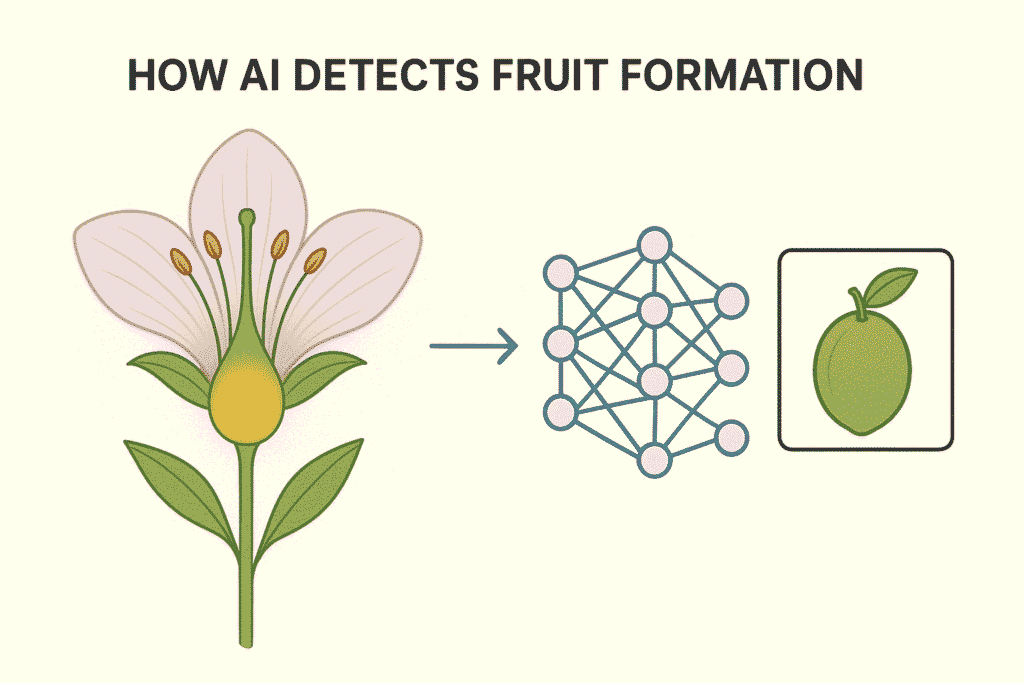
Modern vision systems spot early fruit set by reading visible signals on blooms and buds. You can train models to watch for petal and sepal drop, plus steady ovary enlargement that marks real development.
Structure detection: models segment the pistil to find stigma, style, and ovary. That lets algorithms localize where fruit growth begins and distinguish pollination marks from false cues.
Position cues and types: teaching a model to read superior vs inferior attachment improves accuracy across many flowers and plants. You also label simple, aggregate, multiple, and accessory types so the system classifies stages correctly.
Environment and dispersal: include wind, insects, water, and animal context in training data. These cues help models learn morphology tied to dispersal and avoid errors from motion or droplets.
- Track color, size, and texture changes tied to seed and pericarp development.
- Flag failures: petal drop without ovary growth or sudden size stagnation under harsh conditions.
- Validate on field images with varied lighting and occlusion for robust deployment.
| Feature | Signal | Model action |
|---|---|---|
| Petal/sepals | Drop or wither | Mark transition start |
| Ovary | Enlargement, color change | Confirm development |
| Environment | Wind, insects, water | Context-aware filtering |
| Fruit types | Simple, aggregate, multiple, accessory | Taxonomy-aware classification |
Conclusion
This concise summary helps you see how a bloom becomes usable yield on your plant. , You now know the ovary is the floral structure that ripens into a fruit while ovules turn into seeds as development proceeds.
Watch pistil parts at the base of a flower for steady enlargement and petal drop. That signal shows early fruit set and guides care like watering and nutrient timing.
Classify what you find as simple, aggregate, multiple, or accessory to avoid confusion across plants. Stress and scarce resources explain why some flowers stop before seed or fruit formation.
Use this information to read your plants, act early, and pair observation with AI tools that detect the same visible cues for fruits at scale.
FAQ
Which part of a flower becomes the fruit?
The ovary at the base of the pistil develops into the fruit after fertilization. Once pollen reaches the stigma and a pollen tube delivers sperm to the ovules, those ovules form seeds, and the ovary wall thickens into the pericarp, creating the fruit structure.
What changes occur from the ovary to the fruit after pollination and fertilization?
After pollen lands on the stigma and fertilizes the ovules, petals and sepals often wither or fall away. The ovary swells as ovules become seeds, and its wall differentiates into layers such as exocarp, mesocarp, and endocarp, depending on the species.
How can you identify early fruit formation on a flowering plant?
Look for the pistil at the flower’s center: the stigma, style, and ovary at the base. Check for pollen on the stigma, signs of pollen tube growth, and a slight swelling at the ovary. Early fruit set shows a firm enlargement; aborted ovaries remain small or shrivel.
How do simple, aggregate, and multiple fruits differ when spotting development?
Simple fruits come from one ovary (examples: oranges, beans, true berries). Aggregate fruits form from one flower with many ovaries (raspberries). Multiple fruits result from fused flowers (pineapple). Each type shows distinct swelling patterns during development.
What are accessory fruits and how do pericarp layers matter?
Accessory fruits include tissues beyond the ovary, like apple flesh. The pericarp layers—exocarp (skin), mesocarp (flesh), endocarp (inner layer)—help you recognize maturity and species differences, especially in nuts and fleshy fruits.
How does AI detect fruit formation from flower images?
AI vision models train on annotated images of flower-to-fruit transitions. They learn cues such as petal and sepal drop, ovary enlargement, color shifts, and seed or ovule indicators to predict fruit set and stage.
Which floral structures do machine vision systems focus on?
Models detect the pistil components—stigma, style, ovary—and note ovary position (superior vs. inferior). They also track surrounding organs like petals and sepals to time developmental stages accurately.
Can AI classify fruit types and growth stages accurately?
Yes. With diverse training data, AI can classify simple, aggregate, multiple, and accessory fruits and estimate growth stages by measuring ovary size, pericarp development, and external cues.
What environmental signals help both you and AI spot a fruit set?
Environmental cues—pollinator visits by insects or animals, wind or water pollination patterns, and local conditions such as temperature and humidity—affect fruit set. AI can incorporate these signals to improve predictions and timing.
How do you tell early fruit set from aborted ovaries under varying conditions?
Early fruit set shows consistent ovary swelling and firm texture. Aborted ovaries often stop growing, discolor, or drop. Stressors such as drought, poor pollination, or pests increase the risk of abortion, which can be monitored visually or with sensor-assisted AI.
Also Read This:-
- 12 Key Benefits of AI in Agriculture and Smart Farming Practices
- How a Smart Gardening System Can Turn You Into a Pro Gardener
- The Future of AI for Teachers in USA Classrooms in 2026
- What Is an AI Soil Sensor and How Does It Help Your Garden?
- The Role of AI in Climate Change: What You Should Know
- How AI in Photography Is Changing the Way We Capture and Edit Photos



Pingback: Easy Ways AI Helps You Improve Your Flower Photography in 2026